Pakistan stands at the threshold of space exploration. Two Pakistani pilots, Muhammad Zeeshan Ali and Khurram Daud, are completing intensive training at China’s Astronaut Research and Training Centre in Beijing. Soon, one will become Pakistan’s first astronaut and the first foreign astronaut aboard China’s Tiangong space station. Final selection is expected by mid-to-late October 2026 (October, 2026, Pakistan Standard Time [UTC+5]).
The chosen pilot will serve as a payload specialist, a role that distinguishes between pilots who operate spacecraft and scientists who conduct research in orbit. Rather than flying the spacecraft, the astronaut will run Pakistan’s science experiments during the mission. Both men beat out roughly 20 finalists from an initial Pakistani pool of pilots and scientists. Notably, selection criteria emphasized not just medical fitness and psychological resilience, but also a rare tolerance for g-forces during launch and landing.
Training involves intensive Mandarin-language instruction, learning spacecraft systems, and adapting to microgravity conditions. The two pilots have spent months memorizing Chinese, spinning in centrifuge drills, and learning to eat, sleep, and repair equipment while weightless.
Amer Gilani, who oversees human spaceflight cooperation at Pakistan’s space agency SUPARCO, explained that pilots were specifically chosen because scientists rarely possess the g-force tolerance required for crewed spaceflight. This practical decision underscores a fundamental challenge in space exploration: the intersection of scientific expertise and physical endurance.
The mission will last roughly one week aboard Tiangong. Pakistan selected four biotechnology experiments from more than 300 proposals submitted by universities in Karachi, Lahore, and Islamabad. These experiments address pressing challenges: combating food insecurity and climate change. Importantly, every experiment was built and pre-tested in SUPARCO’s own laboratories before Chinese engineers approved them. It will be a rare case where Pakistani technology receives validation on an international platform, a distinction that carries weight for the country’s scientific credibility.
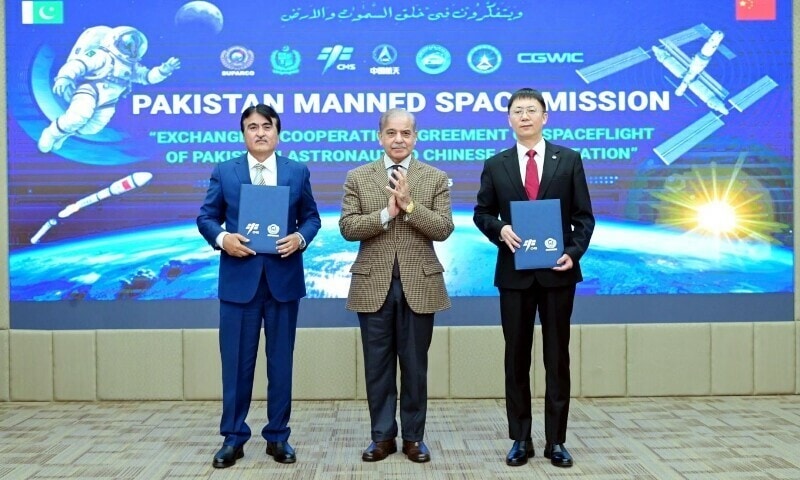
Meanwhile, this mission reflects broader Pakistan-China cooperation that was conceived in 2019. In February 2025, SUPARCO and the China Manned Space Agency signed a formal agreement sending two Pakistani astronauts for training. Subsequently, the countries reaffirmed the program in May 2026. Beyond human spaceflight, Pakistan and China collaborate on satellite launches, a joint satellite-navigation system, and a Pakistani-built rover scheduled for China’s Chang’e 8 lunar mission around 2028. Collectively, these partnerships demonstrate how Pakistan is leveraging international relationships to advance its space ambitions.
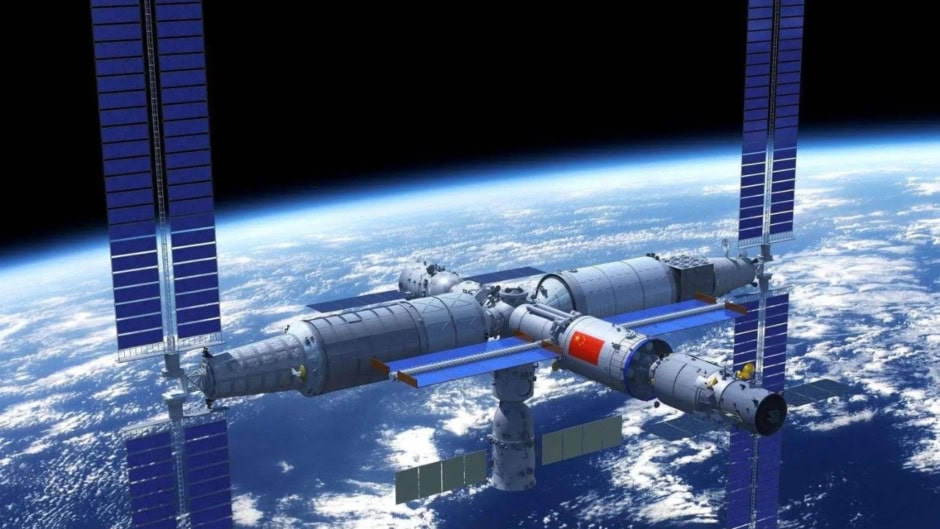
Tiangong operates three modules: Tianhe, Wentian, and Mengtian. Combined, these modules weigh 77 metric tons and house roughly 14 experiment racks. The station has already hosted more than 180 experiments and produced over 500 research papers and 150 patents. By comparison, the Pakistani payload is modest. Yet its significance lies not in scale but in symbolism: it marks Pakistan’s entry into crewed space exploration and demonstrates that Pakistani research can meet international standards.
The astronaut will fly aboard a Chinese-built spacecraft launched from a Chinese site. Training occurs entirely under Chinese instructors, and all communications happen in Mandarin. This arrangement highlights Pakistan’s current dependence on international partners for human spaceflight access. Frankly, Pakistan does not yet possess its own crewed spacecraft or launch vehicle. However, this mission represents a strategic stepping stone. By collaborating now, Pakistan builds experience and expertise that could eventually support independent space activities.